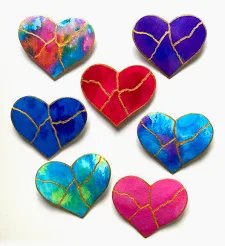
Brokenness is a state that all too often carries enormous shame. I’ve heard clients say, “I’m just broken,” as if being injured or anguished is somehow a defect in character. I think it’s stupid to view brokenness as a negative, because who among us hasn’t been smashed to pieces at some point in our lives?
Is it painful? Yes. Are we defective? Absolutely not. Suffering is not a failure, and if you think it is, maybe you’re just kind of an asshole. Learn some empathy.
Being broken is something that is very rarely caused by our own doing. It happens when an external force exerts pressure so forcefully that eventually something snaps.
Would anyone fault a person who fractures a collar bone after falling down a flight of stairs? No, that’s ridiculous. You’d blame the external forces: gravity, stairs, a hard landing, and maybe some ill-fitting footwear – unless you really are kind of an asshole, in which case, refer to my early comment about empathy.
Still, for some reason, people blame themselves for their emotional brokenness, without even stopping to consider that it wasn’t their fault, but rather that a different sort of gravity was grinding down.
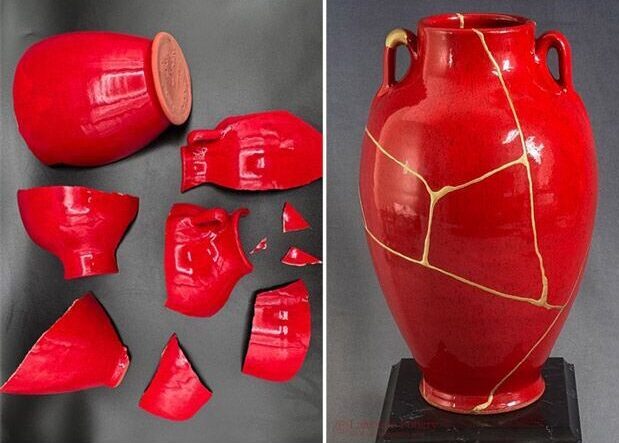
In Japanese culture, the art of pottery repair is called kintsugi. In kintsugi, the broken fragments of a bowl or plate are meticulously joined back together with lacquer and gold, making the damaged piece whole again, but altered in the loveliest way. The finished results are typically stunning and the imperfections only serve to add character and complexity that enhance the original piece.
One Christmas several years ago, I gave my father a piece of kintsugi that I made by hand. I took a dull gray bowl, broke it, glued the pieces back together, then painted the cracks with gold. It took days of frustrating attempts and several sacrificial bowls to create. The final product was a bit wonky, but I was proud of it, and I’m working on allowing myself to be messy anyway, so at least I was being consistent.

Merry Frickin’ Christmas. No, you can’t eat cereal out of it.
That particular gift held deep meaning for me. As a therapist (and for myself), I routinely use kintsugi as a metaphor for suffering. It represents our own unique brokenness, requiring gentle repair that alters us in the most exquisite new way. For me, it’s the ideal symbol for hope and healing, beauty for ashes, and how pain can shape us into something even better.
As my father turned the bowl over in his hands, I quickly tried to explain the meaning behind the Christmas present, but it was pointless. His frown said it all, but he felt compelled to add, “You can’t even eat cereal out of this.” Ah, a master class in adding insult to injury. Dick. The crowd of 20+ family members laughed, and I faked a chuckle because in that moment I felt like a piece of broken pottery myself. I didn’t realize that the utility of a breakfast vessel was the appropriate metric. Silly me.
My mom ended up taking the bowl for herself, as she usually does with all of the Christmas, birthday, and Father’s Day gifts that my father bluntly rebuffs. It’s her way of layering more gold over the old cracks, strengthening the ones I had patched up myself over the years.
With kintsugi, the finished product is the focus. The broken vessel whose flaws make a thing more beautiful has become an increasingly popular symbol of the wounded human being, especially in healing spaces, but what about the process itself?
During the grueling, sometimes dangerous work of cobbling our jagged pieces back together, we risk being cut by sharp edges, or letting discouragement set in when the parts slip and won’t quite fit the way we’d like them to. Still, we know deep down that the repair is worth it because without the breaking, the possibility of transformation doesn’t exist.
Very few people get to see the full creative process – the anguish felt or the tiny cuts on the hands of the maker. We see the gilded veins that make it pretty, but forget that the real healing is not the end result, but rather how we got there. We refuse to ignore the drops of blood on the floor, and when the gravity of pain and trauma crush down, we stagger through it anyway to become something wholly new and beautiful.


Leave a Reply